
A commercial roof in Tucson fails from the top down. UV breaks the surface, thermal cycling between 110-degree afternoons and cool nights opens seams, and monsoon water finds whatever the sun has already weakened. A coating stops that sequence if it is the right chemistry for the substrate and it is applied over a roof that was properly prepared.
Bob’s Custom Roofing has coated commercial roofs across Greater Tucson since 1972. We apply silicone, elastomeric and aluminum systems, and we tell you when a coating is the wrong answer.
Tucson’s intense desert sun makes roof coating particularly valuable. Reflective coatings reduce surface temperatures by 50-70 degrees, cutting air conditioning loads substantially. Commercial buildings with extensive roof areas see measurable monthly savings. Coating also seals minor surface defects, prevents further deterioration, and adds years to roof life.
Extend roof life and cut cooling costs. Call us
Understanding Commercial Roof Coating Benefits
Coating application costs 25-40 percent of a complete roof replacement while delivering 10-15 additional service years. This economic advantage makes coating attractive for properties with structurally sound roofs that show signs of surface aging. Property managers appreciate delaying major capital expenditures while maintaining adequate building protection.
Energy savings justify coating investment quickly in the Tucson climate. Large commercial buildings cooling thousands of square feet see substantial monthly electricity reductions. Cool roof coatings reflect solar radiation rather than absorbing heat. Lower roof surface temperatures translate directly to reduced air conditioning demand during extended Arizona summers.
Coating protects underlying roof systems from continued UV degradation. Desert sun breaks down roofing materials relentlessly. Protective coating layers shield existing systems, preventing the accelerated deterioration that shortens roof life. This protection proves particularly valuable on roofs approaching but not yet requiring replacement.
Reduce energy costs with cool roof coating. Contact us
Coating is not one product. The chemistry has to match the substrate, the drainage and the budget, and choosing wrong is how roofs end up recoated twice in five years.
Elastomeric coatings provide flexible, breathable protection suitable for most commercial roof types. These water-based systems stretch and contract with temperature changes, accommodating building movement without cracking. White pigmentation delivers excellent solar reflectivity. Application goes smoothly in Tucson’s dry climate, allowing rapid project completion.
Elastomeric systems work well on built-up roofing, modified bitumen, and prepared concrete surfaces. Multiple coat application builds protective thickness gradually. These coatings perform reliably for 10-15 years with proper surface preparation and application technique.
Silicone coatings excel in ponding water areas where other systems degrade. Superior water resistance makes silicone ideal for low-slope commercial roofs with drainage challenges. These coatings remain flexible across extreme temperature ranges, important for Tucson’s day-night temperature swings.
Silicone application requires dry conditions and proper surface preparation. Once cured, these systems provide outstanding waterproofing and UV resistance. Silicone coatings typically last 15-20 years, offering excellent long-term value despite higher initial costs than elastomeric alternatives.
Aluminum coatings deliver maximum solar reflectivity, making them valuable for energy-focused applications. These systems reflect heat effectively while providing good waterproofing. Aluminum coatings suit built-up roofing particularly well, renewing aged surfaces economically.
The application requires proper mixing and maintaining the aluminum particle suspension. Once applied, these coatings create bright, reflective surfaces that stay cooler than darker materials. Performance lasts 7-10 years before recoating becomes necessary.
Compatibility with the existing surface is the step most often skipped. A silicone topcoat over an acrylic base will not bond properly, and the failure shows up in the second summer, not the first. We identify what is already on the roof before quoting.
Coating runs roughly 25 to 40 percent of the cost of a full replacement and adds 10 to 15 years to a roof that is structurally sound. For a property manager deferring capital expenditure, that arithmetic is usually decisive. Where a roof needs more than a surface treatment but less than a tear-off, commercial roof restoration sits between the two.
It only works on a sound roof. If the deck is compromised, if there is saturated insulation below the membrane, or if the substrate has failed rather than weathered, coating seals the problem in instead of solving it. In those cases commercial roof replacement is the honest answer. We will tell you when that is the case, because a coating over a wet roof fails and takes our name with it.
A coated commercial roof in Tucson is a maintained system, not a finished one. Most systems want attention around the five-year mark, and a recoat before failure is a fraction of the cost of a recoat after it. Foam roofs in particular depend on the coating remaining intact — once UV reaches the foam, damage is no longer cosmetic.
We can set your property on a scheduled inspection cycle so the recoat happens on your budget calendar rather than during a monsoon.
Know what is on your roof before you coat it. Call us:
Successful coating application demands thorough surface preparation. Shortcuts during prep work guarantee premature coating failure regardless of material quality. We execute preparation systematically, ensuring proper coating adhesion and performance.
Cleaning removes dirt, debris, and biological growth that prevent coating bonding. Power washing eliminates accumulated desert dust and organic material. Chemical treatments address stubborn contamination. Surfaces must dry completely before coating application begins.
Existing damage requires repair before coating. Blisters get cut out and patched. Loose materials need removal. Seams showing separation require resealing. Proper repairs create a stable substrate, allowing coating systems to perform as designed.
Priming proves necessary on certain substrates. Porous surfaces absorb coatings excessively without a proper primer. Incompatible materials need a primer to create a bonding layer. We apply appropriate primers based on existing roof material and the selected coating system.
Professional preparation ensures coating success. Call us:
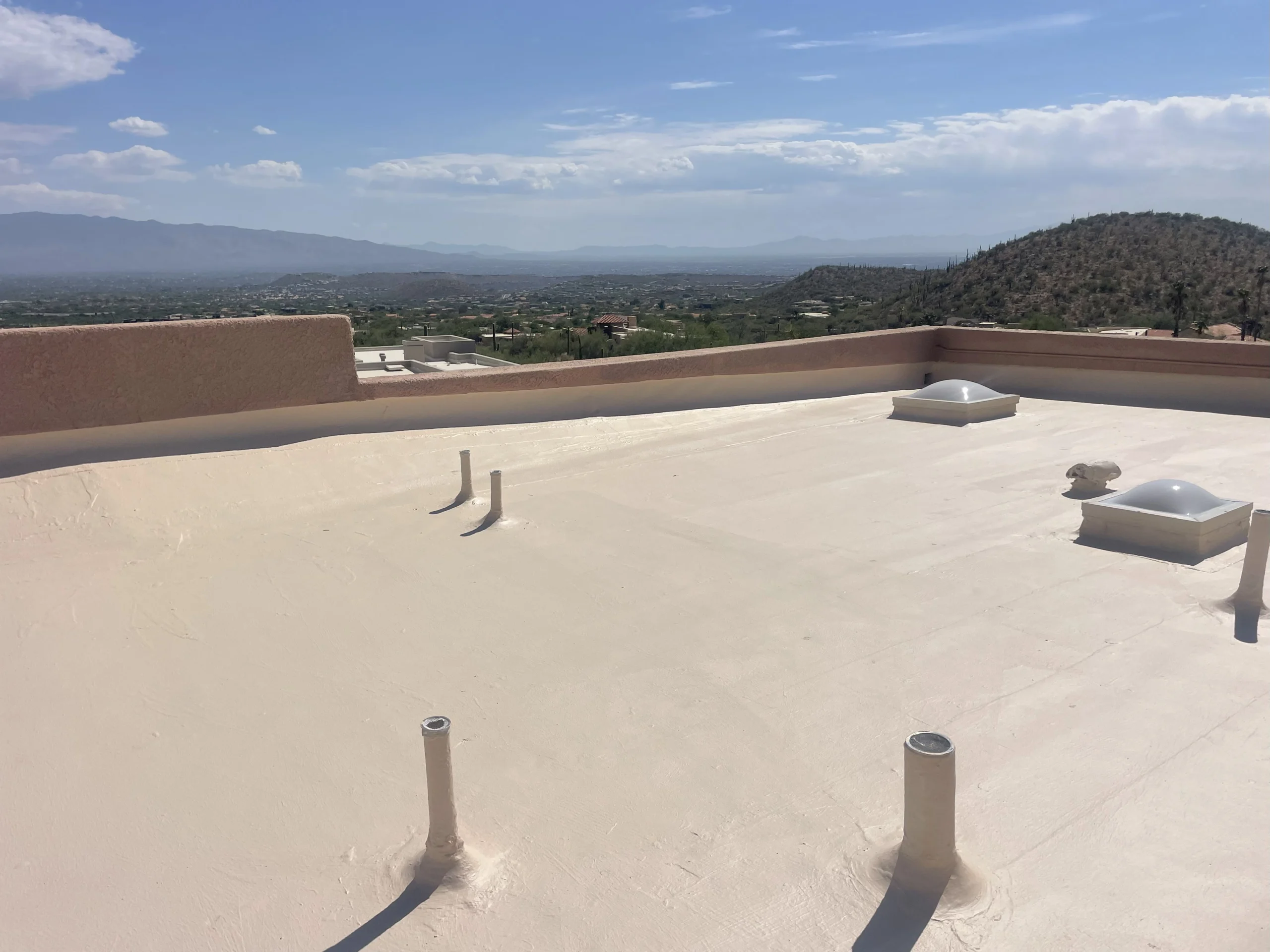
Successful coating requires specific environmental conditions. Temperatures must stay between 50-90 degrees Fahrenheit for optimal curing. Tucson’s dry climate speeds drying times, but any rainfall within 24 hours after application damages uncured systems. We monitor weather forecasts carefully and schedule work during favorable periods to ensure proper coating performance.
Building protective thickness happens gradually through multiple coats. The base coat fills surface texture and establishes foundation adhesion. Intermediate layers build film thickness to specified standards. Final coats provide UV protection and maximum reflectivity. Each layer must dry completely before applying subsequent coats. Rushing this process creates weak systems prone to premature failure.
Application equipment significantly impacts final quality. We use airless sprayers for efficient coverage across large commercial roof areas. Roller applications handle detailed work around edges, penetrations, and transitions. Properly maintained equipment ensures uniform coating thickness throughout every project, eliminating thin spots that compromise protection.
Commercial roof coating provides cost-effective life extension while improving energy performance. Bob’s Custom Roofing delivers professional coating services helping Tucson businesses protect buildings and reduce operating costs. Our systematic approach ensures coating systems perform as designed, delivering the energy savings and roof protection property owners expect.
The best coating depends on your roof and how it’s used. Silicone excels where ponding water is a concern and holds up to relentless UV without chalking. Elastomeric acrylic is a cost-effective, highly reflective choice for roofs with good drainage. Aluminum coatings suit metal and modified-bitumen roofs where reflectivity and a tough finish matter most. During a free site assessment we evaluate your roof’s slope, drainage, substrate, and condition, then recommend the system that delivers the longest service life for your budget.
Frequently
Asked Questions
Depending on the system and the number of coats, a quality coating lasts 10–20 years — and most are recoatable, so the roof’s life can be extended again rather than torn off.
Silicone handles ponding water and UV best, acrylic offers cost-effective reflectivity for well-draining roofs, and aluminum suits metal and modified-bitumen surfaces. We recommend the right one after assessing your roof.
A coating seals minor leaks, seams, and surface cracks as part of a monolithic membrane. Significant damage or wet insulation must be repaired first — we’ll tell you honestly which situation you’re in.
A coating typically costs a fraction of a full tear-off and replacement, while extending the roof’s service life and reducing disruption to your business.
Yes. We schedule around extreme heat and monsoon timing to ensure proper curing and adhesion.
Yes. Reflective coatings lower rooftop surface temperatures, which reduces heat transfer into the building and eases the load on your air conditioning.
Call or text 520-888-6707 email info@bobscustomroofing.com, or visit our office at 2560 W. Zinnia Ave, Tucson, AZ 85705. Free leak detection inspections. Monday-Friday, 8:00 AM – 4:00 PM. Serving all Greater Tucson areas. Trust Tucson’s leak detection specialists since 1972.